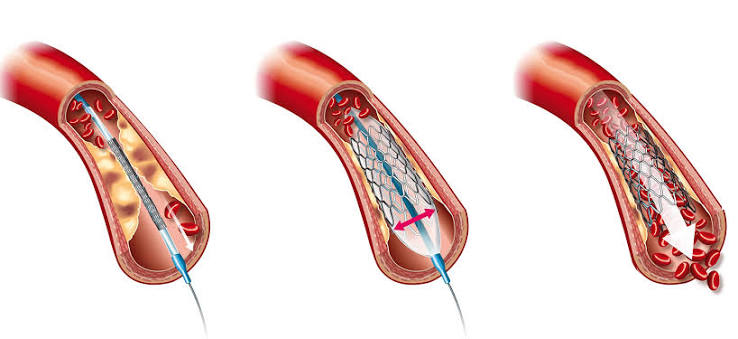
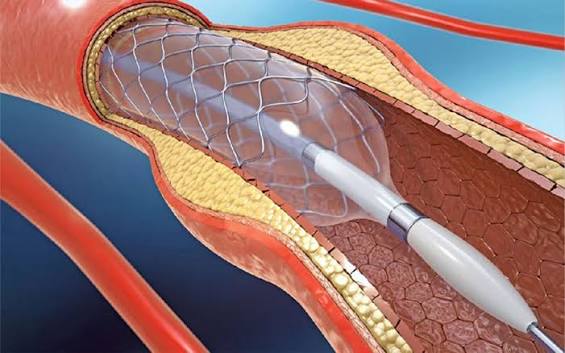
Heart stent surgery is an interventional procedure performed to reopen blocked or narrowed heart vessels. In this procedure, a thin metal mesh (stent) is placed inside the vessel and provides support to the vessel wall. Thus, blood flow to the heart muscle is restored to normal.
Stent application is generally performed using the angiography method and does not require open surgery. This procedure, which is performed under local anesthesia, is both a safe and quick-acting method.
✓What is a Stent?
Stent; is a tubular scaffold used in the treatment of heart vessel blockages. It is made from metals such as chromium, cobalt and platinum. After Angiography (coronary Angiography), your doctor may recommend stent placement. The most common reason for this recommendation is that narrowing or blockage has been detected in your heart vessels as a result of the Angiography. The stent procedure ensures that the vessel remains open. In most cases, the reason for performing Angiography is that patients are suffering from chest pain. When the narrowing is opened, chest pain also disappears. Chest pain may have been present for a relatively long time or may have started suddenly. For this reason, stent is placed in a planned manner, that is, in non-emergency conditions in some people, while in others it is placed in emergency situations such as a heart attack.
✓What tests are performed before the stent procedure?
An EKG is taken before the procedure. A blood test is also performed to check for bleeding risk, kidney function and infection.
✓How long does the stent procedure take?
Generally, 40-60 minutes. However, this time may vary depending on the characteristics of the vessel and how many vessels will receive stents. A procedure applied to a straightforward vessel can be completed in 30 minutes, while a complex case may take 3-4 hours.
✓Is the patient put to sleep during stent placement?
Only the vessel entry site will be numbed so you do not feel pain. You will be awake throughout the procedure. However, relaxing medications may be given to relieve your tension. These may put you in a slightly drowsy state; this is normal.
✓What are the risks of the stent procedure?
Like all interventional procedures, there are certain risks in stent procedures. Each of the serious complications occurs in 2 out of every 1000 people. Risk actually varies from person to person. For example, emergency procedures performed during a heart attack or procedures performed on patients with additional serious illnesses are more risky even if performed by the most experienced doctors.
✓Possible complications
Leg or wrist vessel damage: Serious bleeding or blockage may develop in the leg (groin) or wrist vessel. Therefore, blood transfusion or emergency vessel surgery may rarely be needed.
✓Heart rhythm disorder: Brief rhythm disturbances that resolve on their own are frequently seen in the procedure, but are not serious. Rarely, emergency situations that cause loss of consciousness and require medication or electric shock may develop.
✓Kidney failure: A contrast agent (dye) that allows us to obtain images in the procedure damages kidneys in 5 out of every 100 patients. The risk is even higher in those who already have kidney problems. For example, in advanced stage kidney failure, the risk is five times higher. Even if kidney damage develops, it usually completely resolves with fluid replacement from the vessel. Sometimes temporary dialysis may be required. The need for permanent dialysis is extremely rare.
✓Allergy: Allergy may rarely develop due to contrast agent. Itchy redness may appear on the skin; this is a temporary condition. Very rarely, allergic reactions may be serious enough to obstruct breathing. All necessary equipment for such emergency situations is available in the Angiography room.
✓Heart attack: If the patient's heart vessels are very narrow, the catheter may damage these vessels. This can lead to blockage of the heart vessels, that is, cause a heart attack. In this case, a stent must be placed immediately to open the vessel. Very rarely, emergency heart surgery (bypass) may be needed.
✓Heart vessel rupture (dissection) or perforation (rupture): These problems develop rarely. In most cases, the problem is solved by emergency interventions performed during the procedure. Very rarely, emergency heart surgery (bypass) may be needed.
✓Stroke: Small fats or clots that break off due to catheter contact with delicate areas of the vessels that allow us to reach the heart may rarely escape to brain vessels. This can cause temporary or permanent stroke.
✓When is discharge after the stent procedure?
After the stent procedure is completed, you will be admitted either to the coronary intensive care unit or directly to the ward depending on the difficulty of the procedure performed. Frequently, you are asked to stay in the hospital for one night. Sometimes we may consider discharge in the evening of the procedure day, sometimes a few days later. We adjust this based on the complexity of the procedure and your clinical condition.
When can physical activities be resumed after stent placement?
You should avoid heavy lifting for the first 1 week. The timing for driving, flying, returning to work, and resuming sexual activity varies depending on each patient's condition; you can ask your doctor when you can start these activities. For most people, this period is 1 week.
What is the difference between a stent and a balloon?
Both balloon and stent are materials used to open blood vessels. There is a high likelihood of the vessel closing again after balloon angioplasty. To prevent this, a stent, which acts as a scaffold, is usually placed inside the vessel. In most cases, the balloon is used before stent placement to widen the narrowed area of the vessel enough for the stent to pass through and to understand the vessel's capacity to open. Additionally, after stent placement, the balloon is often inflated inside the stent in the final stage to ensure the stent sits properly against the vessel wall and opens smoothly.
What is the difference between a stent and angiography?
Angiography does not provide any treatment to the patient. This is because no intervention is performed on the vessel; the vessel is only visualized. A stent is a device used to open a blood vessel if a narrowing is detected in the vessel during angiography. In other words, angiography is a diagnostic method, while stent placement is a treatment method.
What is the success rate of stent placement?
The success rate is generally above 90%. The likelihood of successful procedure decreases in the following situations: patient being very elderly, the blockage existing for a very long time (CTO), calcified or tortuous vessel structure, chronic kidney failure, and inadequate interventional technique (the doctor's lack of experience)... In summary, the success rate differs for each patient.
If stent placement fails, will the patient's condition worsen?
In case of failure, the condition of your vessel structure generally remains the same. Therefore, your symptoms will not worsen compared to their initial state.
How many stents can be placed in the heart at maximum?
Many people believe that a maximum number of stents can be placed in the heart. For example, "No more than 5 stents can be placed in the heart." This belief is incorrect. Yes, placing a large number of stents means an increase in the risks that each stent can cause. A cardiologist following current scientific data should try to solve the problems with the minimum number of stents that should be placed in treating the disease.
What is a drug-eluting stent?
A drug-eluting stent (DES) is a stent that contains medication in its metal components. These medications control the proliferation of vessel cells found in the vessel wall that the stent contacts, preventing excessive tissue growth. Thus, the frequency of in-stent stenosis (ISR: In-stent stenosis) is reduced. However, the reason for the development of in-stent narrowing is not solely whether the stent is drug-eluting or not. The patient's genetic predisposition and technical inadequacies in stent placement can also cause this.
Does a stent prevent a heart attack?
We now know clearly that stent placement saves lives when applied in emergency situations such as a heart attack. However, stent placement is often applied as a result of investigating non-emergency but patient-troubling chronic complaints such as chest pain and shortness of breath. In these cases, the main purpose of the stent is to relieve the symptoms. The stent's success in preventing a heart attack is actually similar in most cases compared to medication use alone. However, narrowing at the beginning of large main vessels is an exception (for example, narrowing in the vessel called LMCA). Placing a stent in these locations is more successful in preventing a heart attack compared to medication use alone.
What is the lifespan of a stent? Can a stent become blocked?
After a technically successful stent placement, if the patient regularly uses their medications, controls risk factors such as high blood pressure and diabetes, and adopts a healthy lifestyle, the likelihood of stent narrowing or blockage is considerably reduced. In complex cases, there are usually problems in more locations, therefore more stents are required.
How long does a patient with a stent live?
Stents do not have a specific lifespan. It cannot be determined with certainty how long a patient receiving a stent will live. Only estimated percentages can be given by looking at statistics of previous patients with the same characteristics. The most important factors negatively affecting this statistic are: technical inadequacy in stent placement, patient being elderly, heart failure, heart valve disease, the presence of serious diseases in other organs, hypertension, diabetes, high cholesterol, smoking, medication non-compliance, and lack of social support.
Stent or bypass?
Cardiac surgeons and interventional cardiologists are two different groups of doctors who treat blood vessel problems. Cardiac surgeons solve vessel problems through surgery (bypass), while interventional cardiologists solve the same problems through non-surgical methods (complex stent procedures).