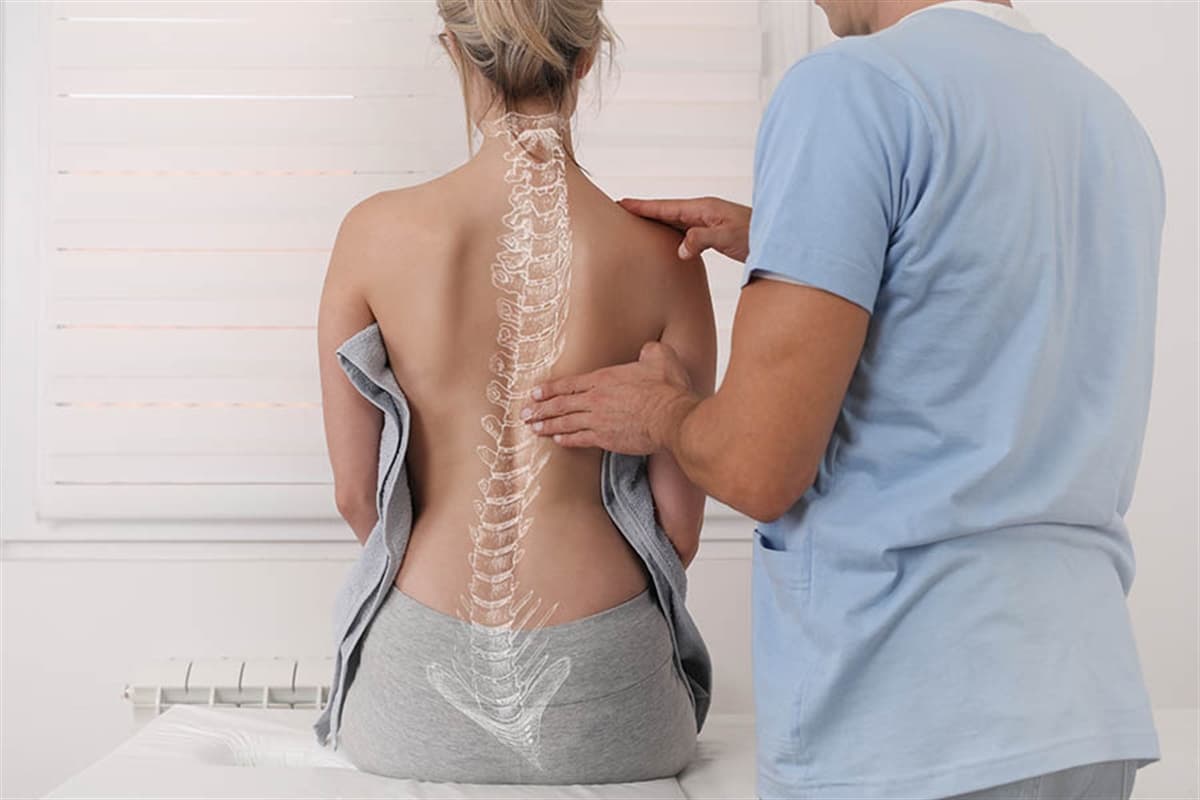
Scoliosis, characterized by curvature of the spine to the right or left, is a common orthopedic problem in modern times. Due to limited mobility and various symptoms of the disease, individuals may experience difficulties in their daily lives. The treatment of the disease, which varies in the degree of curvature, is planned according to this degree and symptoms. Spinal curvature, which has a very low chance of spontaneous correction, can be treated through physical therapy, scoliosis exercises, and surgical interventions.
✓What is Scoliosis (Spinal Curvature)?
The answer to the question "what is scoliosis" is the shape deformities and lateral curvatures seen in the lower back and chest regions of the spine. Spinal curvature, which is an orthopedic disorder, can occur on its own or together with kyphosis or hunchback. Although the causes of scoliosis are not fully known, it can develop due to conditions such as cerebral palsy. Additionally, vitamin deficiencies, diabetes, spinal injuries, infections, and hereditary factors can cause congenital or acquired scoliosis.
✓The Onset of Scoliosis
Scoliosis can begin anywhere in the spine. Scoliosis that occurs at birth or develops later can affect people of any age; however, it typically appears during adolescence. Signs such as protrusions on the back, asymmetric positioning of the shoulders and hips are effective in identifying scoliosis in its early stages.
✓Symptoms of Scoliosis
Bending of the spine to the right or left,
✓Visible curvature in the spine,
✓Asymmetry in the shoulders and hips,
✓Difficulty standing upright,
✓Shortness of breath,
✓Problems while walking,
✓Back, lower back, and shoulder pain,
✓Clothes not fitting the body properly.
✓Diagnosis of Scoliosis
Scoliosis diagnosed in the early stages allows treatment to produce much more positive results. For this reason, thanks to school screenings, particularly in adolescent children, there is an opportunity to intervene in scoliosis without the need for surgical operation.
✓In adults, physical examination is required for scoliosis diagnosis. During the examination, patients are asked to bend forward in order to see the curvature. At the same time, the curvature is visible to the eye while patients are standing.
✓In addition to examination findings, imaging methods are also utilized in scoliosis diagnosis. The degree is determined according to scoliosis X-ray results taken while patients bend forward, sideways, or backward. Along with X-rays, magnetic resonance imaging (MRI) and computed tomography (CT) are also used in diagnosis. Patients showing symptoms such as pain in the legs and back regions and intestinal problems generally benefit from MRI. However, in scoliosis with curvatures higher than 40 degrees, computed tomography is requested to better visualize the bones and spine.
✓How is Scoliosis Identified in Infants?
Although scoliosis is generally seen during adolescence, it can also occur in infants. For this reason, many people wonder why scoliosis occurs in infants. Congenital scoliosis, also known as congenital scoliosis, is progressive, so early diagnosis is of great importance. Abnormal protrusions on the back, color changes in the skin, and hair growth in the back region are observed. At the same time, imaging methods, particularly X-ray radiography, are also used in the diagnosis of scoliosis in infants.
✓Degrees of Scoliosis
Spinal curvatures are measured in degrees. For a condition to be called scoliosis, the curvature must be 10 degrees or more. Curvatures of 10 degrees of scoliosis and below are not scoliosis but spinal asymmetry.
✓Scoliosis degrees are divided into three categories: mild, moderate, and severe. Mild scoliosis is curvature of less than 20 degrees. A 20-degree scoliosis image generally indicates that treatment is not needed. However, patients should have regular check-ups to understand whether there is an increase in curvature.
✓Curvatures between 20 and 40 degrees are called moderate-level scoliosis. A 20 or 30-degree scoliosis image, usually diagnosed between ages 10-15, is improved with bracing and physical therapy.
✓In severe scoliosis, the curvature is above 40 degrees. Curvatures at and above 40 degrees of scoliosis show severe symptoms, so most patients are treated with surgical operation.
✓How is Scoliosis Degree Calculated?
Scoliosis grading is done using imaging methods. Computed tomography, radiography, and MRI are methods used in degree calculations.
✓When Does Scoliosis Progression Stop?
Many people with spinal curvature research whether scoliosis progresses. Although scoliosis is an unavoidable condition, the progression of the disease can be stopped through various treatment methods and with age. How old does scoliosis progress until is one of the points people wonder about. Generally, scoliosis that appears at a young age and progresses until the end of adolescence either completely stops or slows down considerably in adulthood.
✓What Scoliosis Patients Should Not Do
Due to scoliosis types and spinal curvature, patients need to avoid certain activities. Particularly, adults suffering from scoliosis can have a more successful treatment process by paying attention to the indicated points.
✓Although regular exercise is recommended for all scoliosis patients, individuals should first avoid very heavy exercise. Exercises that strengthen back muscles and help reduce pain also increase the movement capability of individuals. Swimming, yoga, and pilates are considered particularly effective in scoliosis treatment. It is beneficial to stay away from strenuous sports activities such as long-distance running or horseback riding that can create pressure on the spine. Particularly, people who have had scoliosis surgery should avoid highly contact sports that can cause trauma.
✓Scoliosis patients can prevent the increase in curvature through certain changes they make in their daily lives. Particularly, working at a desk for very long periods is one of the movements that should be avoided. However, to prevent increased lower back and back pain, one should not sleep on their stomach. Using too many pillows while sleeping is also not recommended.
✓Scoliosis Treatment
Scoliosis treatment is planned and personalized taking into account patients' age, the degree and location of curvature, the severity of pain in adults, physical examination and imaging method findings, and the increase seen over time in the degree of curvature. Early diagnosis made through scoliosis X-rays and examination greatly increases the success of scoliosis treatment.
✓Observation, bracing therapy, physical therapy, and surgical operation are applied in the treatment of scoliosis. Observation, which is the first treatment option, is generally applied in curvatures below 20 degrees and shows how much the curvature has increased over time. Scoliosis physical therapy applications and surgical operation are particularly suitable for adults and more severe cases. However, both in children and adults, surgical operations are resorted to as a last option for scoliosis treatment.
✓Scoliosis Surgery
Scoliosis surgery is performed when the progression of curvature cannot be stopped through non-surgical methods and symptoms persist. For this reason, those with advanced spinal curvature research what scoliosis surgery is. For those complaining of severe pain, problems in intestinal function, and loss of strength in muscles, surgery is the correct treatment method.
✓In adults who have completed their development, spine-stabilizing operations are generally applied. Spinal fusion is the procedure in which bones taken from a part of patients' bodies, as well as metal rods, wires, and screws, are used to correct spinal curvature. Particularly in young children under 10 years old, fusion surgery is not recommended. In these children, specially manufactured rods are used to stop the curvature. This surgery, which does not negatively affect lung development, is repeated as children grow and the rods are lengthened.
✓The recovery period after scoliosis surgery is longer compared to other operations. Patients kept under observation for the first 1 week can return to their daily lives within 1 month, and from the 3rd month onwards, they can engage in sports activities.