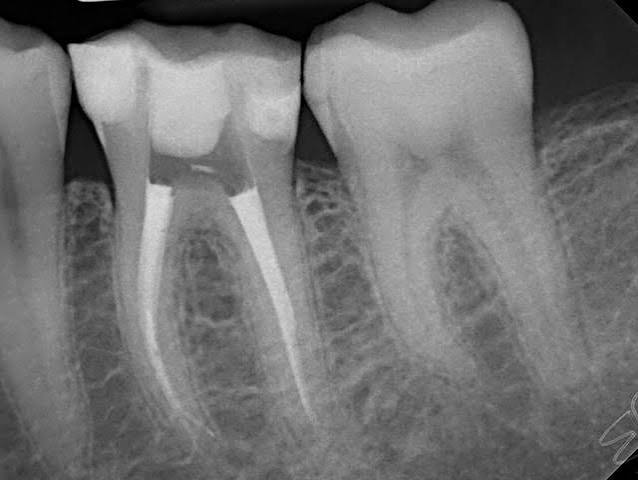
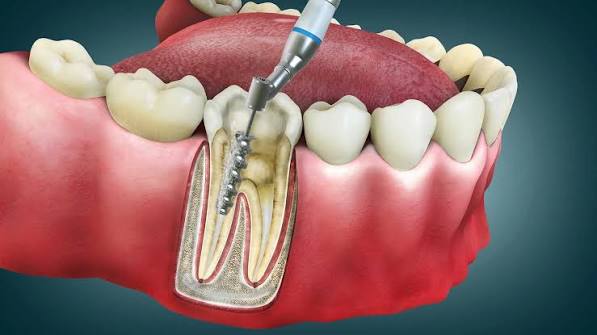
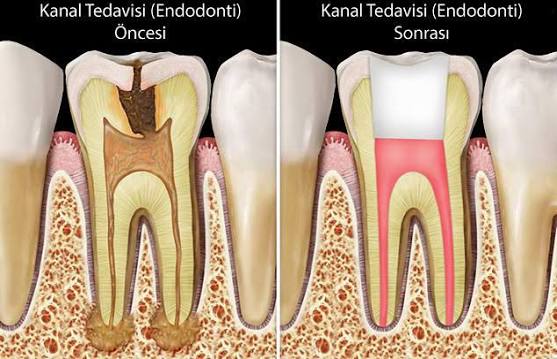
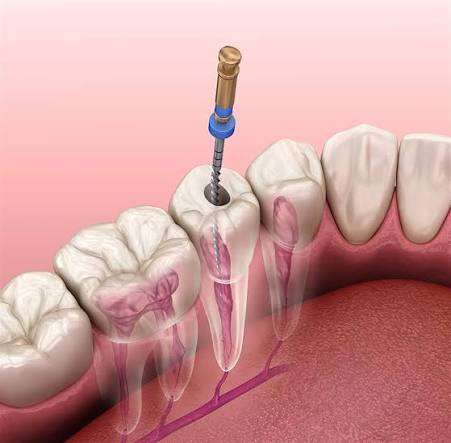
Root canal treatment (endodontics) is a treatment procedure performed to save a tooth instead of extracting a severely damaged or infected tooth. The living pulp from the innermost part of the tooth is removed, the interior of the tooth is cleaned and disinfected, and a filling is placed in the tooth to close the resulting void. Root canal treatment is basically a procedure applied to treat infection in the center of the tooth. Root canal treatment can be applied to every tooth. The duration of the treatment may be prolonged depending on the situations where the tooth becomes infected and the number of affected canals.
✓Treatment Stages
Anesthesia:: The tooth and surrounding gums are numbed with local anesthesia, so no pain is felt.
Cleaning:: The diseased and infected nerve tissue (pulp) inside the tooth is removed with special instruments.
Shaping and Filling:: The canals are washed and disinfected, then sealed with a special filling material to prevent leakage.
✓Symptoms
Deep cavities, severe tooth pain, throbbing at night, sensitivity to hot and cold, or tooth fractures require this treatment.
✓Duration
Usually completed in a single session or within 1–2 sessions depending on the complexity of the case.
✓Is Root Canal Treatment Difficult?
Root canal treatment, which is based on removing the infected pulp for various reasons, cleaning the canal space, and filling it with tissue-compatible materials, is quite simple thanks to the possibilities brought by advancing technology, contrary to the common belief held by the public. When performed under the management of a specialist endodontist, 100% success can be achieved in treatment.
✓When Is Root Canal Treatment Performed?
Root canal treatment is applied when there is a cavity in the tooth or cracks form in the tooth bone. Additionally, root canal treatment can be applied to save a dead tooth and prevent loss of bone structure when the tooth is seriously damaged.
The tooth consists of 3 main layers. On the outermost surface of the tooth are the enamel and the dentin layer beneath it, which form the hard surfaces of the tooth. On the inner surface of the tooth is the living pulp layer containing the blood vessels and nerves that nourish the tooth. When tooth decay penetrates all these layers and reaches the pulp, an infection develops in the tooth. This means damage to the pulp and death of the nerves in it.
Root canal treatment is performed to prevent tooth loss. Tooth loss can lead to loss of activity in that area and erosion of the jawbone. Additionally, tooth loss can negatively affect the patient aesthetically, socially, and psychologically. The process of cleaning the cavities caused by infection that extends to the pulp and root canals of the tooth, shaping the canals, and then filling the canal without leaving any entry point is called root canal treatment. The purpose here is to prevent the passage of substances from the tip of the tooth root into the mouth and from the mouth into the tip of the root. In very advanced cases, the infection can also affect the jawbone.
✓Factors Determining Prices
Number of Canals: Single-canal front teeth are more affordable. The cost increases with double or three/more canals in molars.
Lesion (Inflammation) Status: The presence of inflammation or lesion at the root tip affects the price as it changes the difficulty of treatment and the number of sessions.
Additional Procedures: Filling or crown costs required after root canal treatment are usually not included in these prices and are added separately.
Re-treatment (Retreatment): Repeating a previously unsuccessful root canal treatment requires a separate cost.
Root canal treatment teeth have lost vitality and therefore have a higher likelihood of fracture. For this reason, very hard foods should not be consumed while treatment is ongoing, and that tooth should not be used excessively. Antibiotic medications can be used to eliminate the infection. In case of any pain, painkillers may also be recommended. After treatment is completed, the same procedures that should be performed after a normal filling should be done. Nothing should be eaten or drunk until the local anesthetic effect wears off. The patient may experience sensitivity for a day or two. A tooth that has undergone root canal treatment can be used for a lifetime. If the tooth has lost excessive structure during root canal treatment, various restorations can be performed using different fillings to support the tooth, restore its function, and extend its lifespan. To maintain oral and dental health after root canal treatment, teeth should be brushed twice daily, and attention should be paid to the use of interdental brushes and dental floss. To maintain oral and dental health throughout life, dental checkups should be done once a year until age 6, and twice a year after age 6.
Is root canal treatment a painful procedure?
When a tooth decays, the tooth becomes defenseless against external factors. When the decay penetrates to the pulp, that is to the tooth canals, it causes infections and the tooth root tip opens into the mouth. Root canal treatment is a procedure that must be performed to save the tooth. It is not optional. A tooth with infection should undergo root canal treatment before filling. Root canal treatment is not a painful procedure. If the tooth is not necrotic, if it is still vital, root canal treatment is performed under local anesthesia.
How long does root canal treatment take?
The total duration of root canal treatment can vary depending on the number of canals to be treated, its location in the mouth, and the infection status, but one session of root canal treatment takes approximately 45 minutes on average. Root canal treatment can be completed in a single session if there is no infection or cyst formation in the pulp. Usually, since the tooth comes with infection, the treatment takes 2 sessions.
Can root canal treatment be repeated?
Root canal treatment is a repeatable treatment. The old filling is cleaned, the tooth is reshaped, medication is applied, and it can be refilled.
How long can a tooth that has undergone root canal treatment be used?
How long can a tooth that has undergone root canal treatment be used?